Why Movement Matters More Than Ever
By John Klibanoff, MD, FAAOS, ABOSD - Vice President, Global Surgeon Relations and Medical Education, Zimmer Biomet - Lt. Col., USA Retired

Millions of people around the world are quietly reshaping their lives around joint pain.
They stop taking the stairs. They leave events early. They give up golf, tennis, gardening, long walks, travel—not all at once, but little by little. Over time, they start organizing their lives around what hurts, because the discomfort they experience with joint pain steals their joy.
And in many cases, they do all of that before they ask for help.
As an orthopedic surgeon for decades, I heard the same sentiment from patients: “I assumed I was just getting older.” That belief is common. It is also one of the biggest reasons people wait too long to seek care.
We need to challenge it. We need to change the mindset.
Greater than 500 million people worldwide are living with some form of arthritis. Yet many still think joint pain is something they are supposed to tolerate rather than a condition they should understand and address. Arthritis Awareness Month, recognized every May, is important for that reason. It is not just about acknowledging the scale of the problem. It’s about helping people understand that they have options. We need to change the narrative to shift from resignation to empowerment. Awareness is the beginning of the comeback mindset.
That shift matters.
Why So Many People Wait and How We Can Change That
People delay care for understandable reasons. Some are worried that seeing an orthopaedic surgeon automatically means surgery. Some are overwhelmed by conflicting information they read online. Some have simply been living with pain for so long that they start to think limitation is normal.
It is not.
The earlier patients engage, the more productive the conversation can be. Sometimes that discussion leads to physical therapy, activity modification, injections, or other conservative measures. Sometimes it leads to surgery. The important thing is that patients understand that they have choices.
That’s why awareness is the first step. If people think pain is just part of aging, they are not going to ask questions. They are not going to seek care. They are just going to keep shrinking their lives around it.
At Zimmer Biomet, Awareness is the first of the four key problems we want to solve moving forward. As Ivan Tornos, Chairman, President and Chief Executive Officer of Zimmer Biomet, has emphasized, helping people recognize when they should seek care is a necessary first step towards better outcomes.

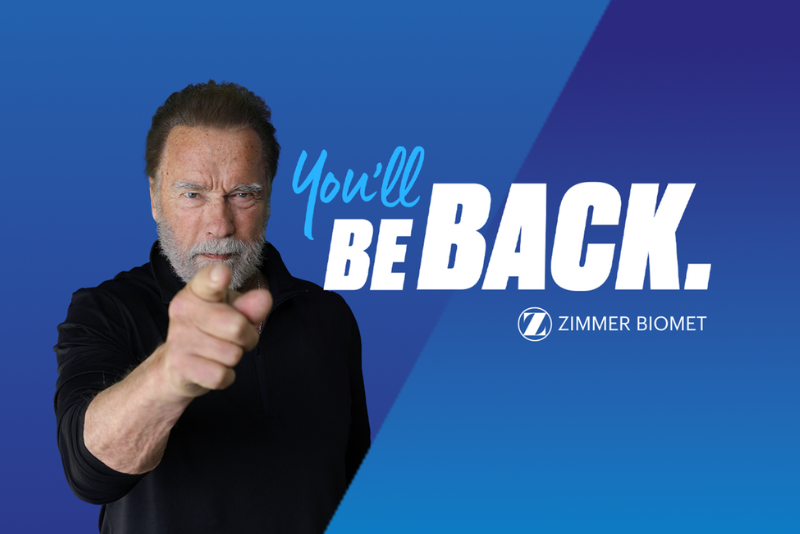
I couldn’t agree more and that is where direct-to-patient education becomes so important. Campaigns like You’ll Be Back and The Personalized Knee, along with visible advocates like our Chief Movement Officer Arnold Schwarzenegger, meet people where they are: at home, online, in the moment they’re wondering whether the pain is “bad enough” or whether there is any point in bringing it up. They need information that is accessible, understandable and grounded in reality.
That’s why public awareness efforts can be so powerful. They help patients recognize themselves in the story and remind people that sitting on the sidelines is not the only path forward.
Schwarzenegger’s voice resonates because he understands the power of a comeback. “The stats don’t lie. Too many people settle for doing less when they don’t have to,” said Arnold Schwarzenegger, Chief Movement Officer, Zimmer Biomet. “When people think pain is just part of aging, they stop doing the things that make them happy. They don’t need to accept that. They shouldn’t accept it. Movement is the best medicine. People need to take control, get informed and start their comeback – today.”
Innovation Should Help Patients Get Their Lives Back
Orthopaedic care and innovation have changed significantly over the past decade, particularly in knee replacement.
Patients now have more options than they once did—including total and partial knee replacements, “smart knee” implants that track post-surgery metrics, personalized knee replacements that come in a broader range of sizes and shapes to closely match natural anatomy. They have robotic-assisted systems that can help surgeons plan and execute procedures and connected care tools to extend support from pre operative preparation and into recovery and give both surgeons and patients visibility into how their surgical journey and recovery progress.
Restoring More Than A Joint
In my work with orthopaedic surgeons around the world, one thing stands out consistently: the best surgeons are not just thinking about x-rays or mechanics. They are thinking about what the patient wants their life to look like on the other side of treatment.
No two patients are the same. They do not have the same anatomy, expectations or definition of success. One patient wants to get back to hiking, another wants to keep up with grandchildren, another to get through the grocery store without stopping and another wants to sleep through the night without pain. Great orthopaedic care starts by understanding that and then matching the treatment plan to the person in front of you.
When we talk about awareness, that is really what we should be talking about. Not just disease prevalence or procedure volume. But that too many people are living smaller lives than they need to because they assume nothing can be done.
A Better Message for Arthritis Awareness Month
Arthritis Awareness Month should remind us that awareness is only useful if it leads to action.
For patients, that may mean asking questions sooner. For clinicians, it means continuing to educate clearly and listen carefully. For those of us in the broader orthopaedic community, it means helping people understand the full range of options available to them.
Joint pain is common and it may increase with age, yet that does not mean people should simply accept it. Talk to a doctor about what you’re experiencing, whether surgery is right for you, about the treatments available and any risks, to find the treatment options that are right for you.
Help exists and treatment is not one-size-fits-all. Most importantly, reclaiming mobility and getting back to the things that matter is a reasonable goal.
Zimmer Biomet is not a medical professional and does not practice medicine.